
أغريكولا
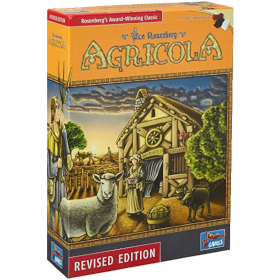 لم يكن القرن السابع عشر وقتًا سهلاً لكي تكون مزارعًا. يبدأ اللاعبون اللعبة باثنين من أفراد العائلة ويمكنهم تنمية عائلاتهم على مدار اللعبة. هذا يسمح لهم بمزيد من الإجراءات ولكن تذكر أنه يجب عليك زراعة المزيد من الطعام لإطعام أسرتك أثناء نموها! يعد إطعام عائلتك نوعًا خاصًا من التحدي وسيزرع اللاعبون الحبوب والخضروات بينما يكملون إمداداتهم الغذائية بالأغنام والخنازير البرية والماشية. أرشد عائلتك إلى الثروة والصحة والازدهار وستفوز باللعبة.
عدد اللاعبين: 1 - 4
مدة اللعبة: 52 mn
تعقيد: 3 / 5
العب أغريكولا و 1412 ألعاب أخرى online.
لا يلزم التنزيل - العب مباشرة من متصفح الويب الخاص بك.
مع أصدقائك وآلاف اللاعبين من أنحاء العالم.
مجاني.


العب أغريكولا و 1412 ألعاب أخرى online.
لا يلزم التنزيل - العب مباشرة من متصفح الويب الخاص بك.
مع أصدقائك وآلاف اللاعبين من أنحاء العالم.
مجاني.
ملخص القواعد
Overview
Welcome to the farm! In Agricola, you'll play as a family of farmers over the course of 14 rounds, steadily building up a mostly empty space into a vibrant farm full of grains, vegetables, and animals, as well as improve the living conditions of your family. Players assign their workers to various spaces on the action board to perform various actions to gather resources or improve your farm, most of which will be used to score points, but periodically, players need to pay food to support the family. The player with the most points after 14 rounds wins!
Game Anatomy
Each player has access to various resources, including:
- • Food, needed to feed your family periodically
- • Wood, needed to build fences, stables, and many improvements
- • Clay, needed to build most major improvements
- • Stone, needed to build other major improvements
- • Reed, needed for some improvements and home renovations
- • Grain and vegetables, which can be planted in your farm
- • A hand of cards, consisting of 7 minor improvements and 7 occupations
- • Workers, represented by meeples. You start the game with 2 of these - the rest can be earned during the game.
Each player also has a board representing their farm, which contains:
- • Your home, represented by different tiles. Your home size and what material it's made of limits the size of your family and scores you additional points at the end of the game.
- • Fields. Grains and vegetables can be planted on these and are picked up during the harvest phase.
- • Pastures and the animals housing them. Pastures are separated by fences, and animals inside them can be cooked for food or held onto for points.
- • Any played improvements or occupations, most of which give various abilities, actions, or scoring opportunities as described on them.
The central board contains the following:
- • The actions players can take. Note that each round, a new action will be added to this, in a loose order.
- • The available major improvements. There are 10 improvement cards that can be built by different players, most of which center on collecting or converting food.
Game Flow
Agricola takes place over the course of 14 rounds. At the beginning of each round, some spaces are stocked with resources, even if they already had resources from a previous round. A new action is added to the board - these new actions are loosely randomized by being sorted into 6 phases, then randomized within each phase. Then each player, starting with whoever has the first player token and proceeding clockwise around the table, takes a turn by placing one of their family members on a particular space, then immediately performing that action. Players can also, as a free action, organize their farm or make certain conversions as described on various improvements. Once they have finished resolving this action, it's the next player's turn. Players continue doing this until all players have placed all available workers. After certain rounds, a harvest phase happens. Then, a new round starts.
Starting Actions
These actions are available from the start of the game:
- • Farm Expansion: Pay 2 reed and 5 of whatever material your house is currently made of (wood by default, to build a new room to your home. This new room must be connected to an existing room. Additionally, you can build a stable on any unoccupied space or a pasture. This stable can hold one animal, or doubles the capacity of an existing pasture.
- • Meeting Place: Take the starting player token. This means you will be the first player to take actions in the next round. This is the only way this token moves - if no one takes this action in a particular round, the same player remains the first player again. Additionally, you may play one minor improvement card from your hand by paying the cost on it.
- • Grain Seeds: Gain 1 grain.
- • Farmland: Add one field to your farm. This field must be adjacent to at least one other field (if any exist).
- • Lessons: Play an occupation card from your hand. The first of these cards is free, but all others cost 1 food.
- • Day Laborer: Gain 2 food.
- • Forest: This space accumulates 3 wood at the beginning of each round. Gain all wood on it.
- • Clay Pit: This space accumulates 1 clay at the beginning of each round. Gain all clay on it.
- • Reed Bank: This space accumulates 1 reed at the beginning of each round. Gain all reed on it.
- • Fishing: This space accumulates 1 food at the beginning of each round. Gain all food on it.
(Other spaces may be available based on the player count.)
Actions In Phase 1
These actions will be added at some point in rounds 1 through 4, but the exact order they appear will be random.
- • Improvements: Gain 1 major or minor improvement by paying its cost.
- • Fencing: Pay any number of wood to build the same number of fences, thus giving you pastures to house animals. You must completely enclose all spaces to be used as pastures this way.
- • Sheep Market: This space accumulates 1 sheep at the beginning of each round. Gain all sheep on it.
- • Grain Utilization: Sow any number of grains or vegetables in any empty fields. If you place a grain in a field, immediately add two more grains on the same field; you will receive one of them each harvest phase. Vegetables work the same way, except you only add one more vegetable to each field. Additionally, you may bake bread by converting grain to food; any cards that allow you to do this will tell you how much food you get this way.
Actions in Phase 2
These actions will be added at some point in rounds 5 through 7, also in a random order.
- • Western Quarry: This space accumulates 1 stone at the beginning of each round. Gain all stone on it.
- • House Redevelopment: Upgrade a wooden house to a clay house, or a clay house to a stone house. To do this, pay 1 reed and 1 of whatever material you are upgrading to per room in your house. You must be able to upgrade the entire house - you can't upgrade individual rooms. Additionally, you may build a major or minor improvement after completing this.
- • Wish For Children: Add a new worker to your family. This can't cause you to have more family members than rooms in your house. This worker will be able to take actions in the following round.
Actions in Phase 3
These actions will be added at some point in rounds 8 and 9, in a random order.
- • Vegetable Seeds: Gain 1 vegetable.
- • Pig Market: This space accumulates 1 pig at the beginning of each round. Gain all pigs on it.
Actions in Phase 4
These actions will be added at some point in round 10 and 11, in a random order.
- • Eastern Quarry: This space accumulates 1 stone at the beginning of each round. Gain all stone on it.
- • Cattle Market: This space accumulates 1 cow at the beginning of each round. Gain all cows on it.
Actions in Phase 5
These actions will be added at some point in round 12 and 13, in a random order.
- • Cultivation: Place one field in your farm, then sow any number of fields as you would have in Grain Utilization.
- • Urgent Wish For Children: Add a new worker to your family. This works the same way as Wish For Children, except that the requirement about rooms in your house is ignored.
Actions in Phase 6
This action will be added in round 14.
- • Farm Redevelopment: Upgrade your house, then build fences. All rules House Redevelopment and Fencing apply.
Harvest
A harvest phase happens immediately after each phase (that is, after rounds 4, 7, 9, 11, 13, and 14). In each harvest, the following things happen in order:
- • FIELD PHASE: Each player takes one grain or vegetable from each field.
- • FEEDING PHASE: Each player pays 2 food for each worker (3 in the solo game, or just 1 if the worker was just added this round and never took an action). Players may freely perform any free actions or exchanges to meet this cost. For each food players are unable to pay, they take a Beggar card, worth -3 points at the end of the game.
- • BREEDING PHASE: If you have at least 2 sheep, pigs, or cows, you gain a new animal of that type. You may immediately rearrange any animals in your farm to place these, but may not convert these to food.
End Of The Game
The game ends after the 14th round and its attached harvest phase. After that, players score for their farm.
The player with the most points wins!
Scoring
| -1 point | 1 point | 2 points | 3 points | 4 points | |
|---|---|---|---|---|---|
| Field tiles | 0-1 | 2 | 3 | 4 | 5+ |
| Pastures | 0 | 1 | 2 | 3 | 4+ |
| Grain | 0 | 1-3 | 4-5 | 6-7 | 8+ |
| Vegetables | 0 | 1 | 2 | 3 | 4+ |
| Sheep | 0 | 1-3 | 4-5 | 6-7 | 8+ |
| Wild Boar | 0 | 1-2 | 3-4 | 5-6 | 7+ |
| Cattle | 0 | 1 | 2-3 | 4-5 | 6+ |
Also:
- • -1 point per unused space in the Farmyard
- • 1 point per fenced stable & per Clay hut room
- • 2 points per Stone house room
- • 3 points per family member
- • -3 points per begging token
- • _ points printed on cards
- • _ bonus points
Banlist
The game options let you enable two community-curated banlists that remove unbalanced cards from the deck. Each is toggled independently:
- Competitive (under "Competitive level") removes overpowered or game-warping cards.
- Ban weak cards removes underpowered cards.
Which cards are removed depends on player count, since the meta differs significantly between 1-2 player and 3-4 player games. A ✓ means the card is removed when the banlist is enabled at that player count. 3+ or 4+ in the 1-2 players column means the card is not available in 1 or 2 player games anyway, because the card is only for 3+ or 4+ player games.
In addition, Living Hand draft mode has its own small banlist (see bottom of this section). These cards are always removed in Living Hand games, regardless of other banlist settings.
Strong banlist
Overpowered or game-warping cards.
| Card | 1-2 players | 3-4 players |
|---|---|---|
| A14 Carpenter's Hammer | ✓ | ✓ |
| A33 Big Country | ✓ | |
| A39 Chapel | ✓ | ✓ |
| A48 Shaving Horse | ✓ | ✓ |
| A82 Work Certificate | ✓ | ✓ |
| A97 Freshman | ✓ | ✓ |
| A127 Lodger | 3+ | ✓ |
| A131 Craft Teacher | 3+ | ✓ |
| A133 Braggart | 3+ | ✓ |
| B10 Caravan | ✓ | ✓ |
| B15 Carpenter's Bench | ✓ | ✓ |
| B21 Hayloft Barn | ✓ | ✓ |
| B22 Walking Boots | ✓ | |
| B40 Brewery Pond | ✓ | |
| B117 Informant | ✓ | ✓ |
| B132 Estate Master | 3+ | ✓ |
| B151 Little Peasant | 4+ | ✓ |
| B161 Weakling | 4+ | ✓ |
| C3 Carriage Trip | ✓ | ✓ |
| C23 Job Contract | ✓ | |
| C28 Teacher's Desk | ✓ | ✓ |
| C31 Writing Chamber | ✓ | ✓ |
| C60 Small Potter's Oven | ✓ | ✓ |
| C63 Craft Brewery | ✓ | ✓ |
| C99 Garden Designer | ✓ | ✓ |
| C102 Tree Guard | ✓ | ✓ |
| C125 Nightworker | ✓ | ✓ |
| D4 Cross-Cut Wood | ✓ | ✓ |
| D19 Pulverizer Plow | ✓ | ✓ |
| D21 Recruitment | ✓ | ✓ |
| D33 Summer House | ✓ | ✓ |
| D74 Royal Wood | ✓ | ✓ |
| D92 Child Ombudsman | ✓ | |
| D97 Begging Student | ✓ | ✓ |
| D110 Fish Farmer | ✓ | |
| D137 Trade Teacher | 3+ | ✓ |
| E22 Guest Room | ✓ | ✓ |
| E105 Pioneer | ✓ |
Weak banlist
Underpowered cards.
| Card | 1-2 players | 3-4 players |
|---|---|---|
| A27 Oven Site | ✓ | ✓ |
| A36 Facades Carving | ✓ | |
| A70 Lifting Machine | ✓ | ✓ |
| A84 Silage | ✓ | ✓ |
| A100 Curator | ✓ | ✓ |
| A107 Catcher | ✓ | ✓ |
| A144 Sequestrator | 3+ | ✓ |
| A151 Minstrel | 4+ | ✓ |
| A154 Paymaster | 4+ | ✓ |
| A167 Breeder Buyer | 4+ | ✓ |
| B38 Future Building Site | ✓ | |
| B52 Growing Farm | ✓ | |
| B101 Furniture Carpenter | ✓ | ✓ |
| B139 Forest Scientist | 3+ | ✓ |
| B147 Huntsman | 3+ | ✓ |
| C12 Cattle Farm | ✓ | ✓ |
| C21 Heart of Stone | ✓ | |
| C34 Elephantgrass Plant | ✓ | ✓ |
| C84 Perennial Rye | ✓ | ✓ |
| C92 Autumn Mother | ✓ | |
| C154 Twin Researcher | 4+ | ✓ |
| C157 Resource Analyzer | 4+ | ✓ |
| C158 Forest Campaigner | 4+ | ✓ |
| D10 Stork's Nest | ✓ | |
| D37 Sculpture | ✓ | |
| D72 Stable Manure | ✓ | |
| D101 Sugar Baker | ✓ | ✓ |
| D116 Tree Inspector | ✓ | ✓ |
| D140 Loudmouth | 3+ | ✓ |
| D165 Pig Stalker | 4+ | ✓ |
| E108 Blackberry Farmer | ✓ | ✓ |
Living Hand banlist
These cards are automatically removed when Living Hand draft mode is selected, regardless of other banlist settings:
- B5 Store of Experience
- B146 Illusionist
- C35 Lantern House
- D48 Civic Facade